Tuesday, July 2, 2013

Family Matters Especially when Caring for an Aging Parent.


"We are so thankful to Family Caregivers for the help they provided at such a difficult time. We could not have done it without them." Niven family
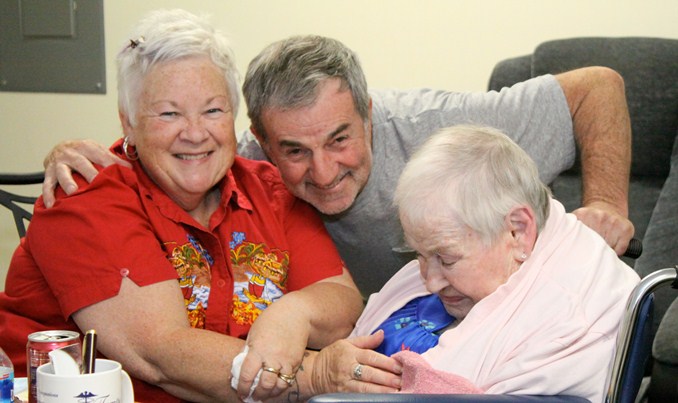
 
 
The American  Association for Marriage and Family Therapy states that “more than ever before, families are providing long-term care to older adults with limitations in the ability to perform tasks necessary for independent living. Nearly 25% of American households are providing care to people age 50 years and over. Families are the alternative foundation for a stressed healthcare system. Hospital stays are shorter than ever and family caregivers are often expected to do what healthcare professionals once did.”

Family caregivers take over various responsibilities for their elders.  It may be just handling finances, running errands, going to doctor appointments or taking on full 24 hour care services.  In most cases one sibling in the family will become the main caregiver, but most successful ventures are supported by the entire family.

There is a saying that it takes a village to raise a child.  This may be true, but it takes a family to care for an aging parent.  As seniors lose physical and cognitive function they become vulnerable and unable to manage their own care.  Who better to know their needs and desires than their own children.  Even if professional care givers are providing services, family involvement makes the difference in quality of life for their parents.

“If one family member has been designated caregiver other members can give support with respite care, transportation to doctors, etc., everyone needs to be aware of all that is needed and be in total agreement to do it”.  “The 4 Steps of LongTerm Care Planning”

Experience has shown that even families that are close can quickly grow angry, jealous and hostile towards each other when an aging parent begins to need long term care. If a sibling moves into the parent’s home, others can easily be suspicious of ulterior motives and fear to lose their inheritance. On the other hand, the child doing the entire care taking becomes bitter and feels there is no support or help from siblings.

One example of a family misunderstanding is that of a brother accusing his sister of stealing all of the money from the sale of his parent’s home.

Karen, who was a single mom with two children, moved in with her parents when her father had a stroke to help her mother take care of him. Her mother was also disabled. Needing money to pay for a home care service, Karen helped her mother do a reverse mortgage on the home, which gave the needed funds. If communication had been open and Karen’s brother had known the need and been involved with his parents care, he would not have reacted so negatively when he eventually found out about the reverse mortgage.

Every family is different. Some families are close and some have never been compatible. If your communication is strained, consider having a professional mediator such as a Geriatric Care Manager or Professional Patient Care Advocate present at a family meeting. The mediator will be able to keep things calm and running smoothly and help work out each persons concern.

Family matters.  The experience of working together for their parents care can give aging parents and family members a peaceful, memorable experience.  Call Family Caregivers Network 215-541-9030 or visit www.familycaregiversnetwork.com for more information or to schedule a visit by a Geriatric Care Manager or Professional Patient Advocate.
 
Article compliments of The National Care Planning Council which Family Caregivers Network is a member of.  Multiple resource information available at Long Term Care Link.

Saturday, June 8, 2013

New Mobile GPS Medic Alert Systems are for aging individuals on the move.

Gerry Fioriglio RN, Owner of Family Caregivers Network
with Dene Liott live on "What's Happening"
 
Get Help wherever you are with the new Mobile Alert GPS system.  Now you can go out and participate in all of your favorite activities - taking walks, gardening, lunching with friends or traveling - and still be able to get help in the event of a sudden fall or medical emergency. MobileAlert, the medical alarm service that uses GPS technology to follow you at home and on the go, ensures that professional help is your constant companion.
 
Did you know that
  • 1 out of 3 Americans age 65 and older fall at least once a year.
  • Chances of surviving a fall are 6 times greater if you're found within the hour.
  • The danger of permanent disability rises dramatically each minute a stroke victim is left 
  •       unattended.
  • Over 20% of the 1.6 million Americans who suffer heart attacks every year die because help
  •       didn't arrive on time.

    Check out the new technology today at "Medical Alert"

    Thursday, November 1, 2012

    Agressive Behavior in Patients with Dementia

    There seems to be an increase in the amount of agressive behavior in patients with Dementia or Alzheimer's disease and families are struggling to understand how to deal with these behaviors.  I usually hear families say "I don't know why my father is behaving like this he was never agressive".   Families still don't understand Dementia let alone the serious issues of agressive behavior. 

    Why do some patient's with Dementia develop agressive behavior and other's don't?  What causes this behavior?  And what can be done to control this behavior?  These are some of the most understood issues with this disease. 

    First families need to understand that it is not the person but the disease causing the agressive behavior.  Usually this type of behavior occurs when the frontal lobe of the brain is affected by the disease Dementia.  The frontal lobe is where a person's personality and behavior sit within the brain. Some people with dementia involving the frontal lobe undergo dramatic changes in their personality and become socially inappropriate, impulsive or emotionally indifferent, while others lose the ability to use and understand language. It is important to have your loved one evaluated by a Neurologist or Neuropsychiatrist who specializes in Dementia in adults.  Once the right diagnosis is made then the patient can be treated appropriately and the family can be educated on what to expect with this very unpredictable illness.  

    The signs and symptoms of this disease often vary from patient to patient.  It becomes progressively worse over time requiring 24 hour care.  Most behavioral changes that a person exhibits are;

  • Increasingly inappropriate actions
  • Loss of empathy and other interpersonal skills
  • Lack of judgment and inhibition
  • Apathy
  • Repetitive compulsive behavior
  • A decline in personal hygiene
  • Changes in eating habits, predominantly overeating
  • Lack of awareness of thinking or behavioral changes
  • Sudden Agression
  • Behavior can change without any warning

  • Once a person has been appropriately diagnosed treatment usually begins with using Antidepressants.  It is usually a long process to find the right combination of medications needed to manage the symptoms.  Often Antipyschotic drugs are needed but they can have adverse affects that need to be closely monitored because of the increased mortality in the elderly. 

    The more that families understand about the illness they can better manage their own behavior around the person with the illness. Families and caregivers can reduce behavior problems by changing the way they interact with the person who has agressive behavior with dementia. Examples include:
    • Avoiding events or activities that trigger the undesirable behavior (sometimes easier said than done).
    • Anticipating needs and alleviating them promptly
    • Maintaining a calm environment
    • If the person is telling a story you know if not true don't try to correct them or tell them it is not true.  Just listen and redirect the individual. 
    • Try to stick to routines.
    • Never assume the individual will not exhibit a specific symptom, remember the behavior can happen without warning. 
    Caring for someone with this type of  dementia can be challenging and stressful because of the extremes of personality changes and behavioral problems that develop. Family caregivers and family members need the support of their friends and professionals. Support groups provide a safety net for many family caregivers.  Put together a care plan that involves not only professional help but also help from others in your community such as church groups.  Often care provided by adult care centers or In-home care agencies are necessary to provide respite to the family.  When the person is end stage with their disease be sure to seek the support of Hospice care. 

    Living with a person with Dementia or Alzheimer's disease is a 24 hour a day job.  Caring for a person with Agressive behavior associated with the disease there just aren't enough hours in a day.  So reach out to others for help.  More more information on Agressive behavior contact us at Family Caregivers Network.  We can direct you to the right help you need.  For anyone who believes they can handle it by themselves or doesn't think it will ever get that bad read the attached article;
    Allentown Police: 86-year-old man shot and killed son